2026 Roundabout Capitals of the UK
Travel Research
One thing that many drivers don’t particularly enjoy encountering on their trips is a roundabout. As a global car rental comparison and booking site that operates in 164 countries here at DiscoverCars.com, we have customers all over the world, which makes us curious about how different countries compare.
Roundabouts are a lot more common in some countries than others, especially in Europe, where they were introduced much earlier – so we wanted to find out which country has the most of all. We’ve repeated our 2023 research with new data from 2026 to find out which countries have the most roundabouts today.
We downloaded OpenStreetMap extract data for each country, which were then filtered to show only elements matching a set of tags identifying them as roads or roundabouts.
Roundabouts on OpenStreetMap may be comprised of separate road sections. Therefore, roundabout elements (marked as roundabouts, traffic circles, or mini-roundabouts) were then matched so that any element within 10 meters was marked as part of the same roundabout. Then, any element within 10 meters of those matching elements was marked as such until there were no roundabout elements within 10 meters.
The countries were then ranked according to the total number of roundabouts, total roundabouts per square kilometer, and total roundabouts per capita (1 million people). Roundabouts per square kilometer have been rounded to two decimal places. This means in some cases several countries may appear to have the same ranking on this metric; however, the raw data shows differences.
Countries with a land area of less than 10,000km, as per data taken from World Population Review, were excluded from the rankings.
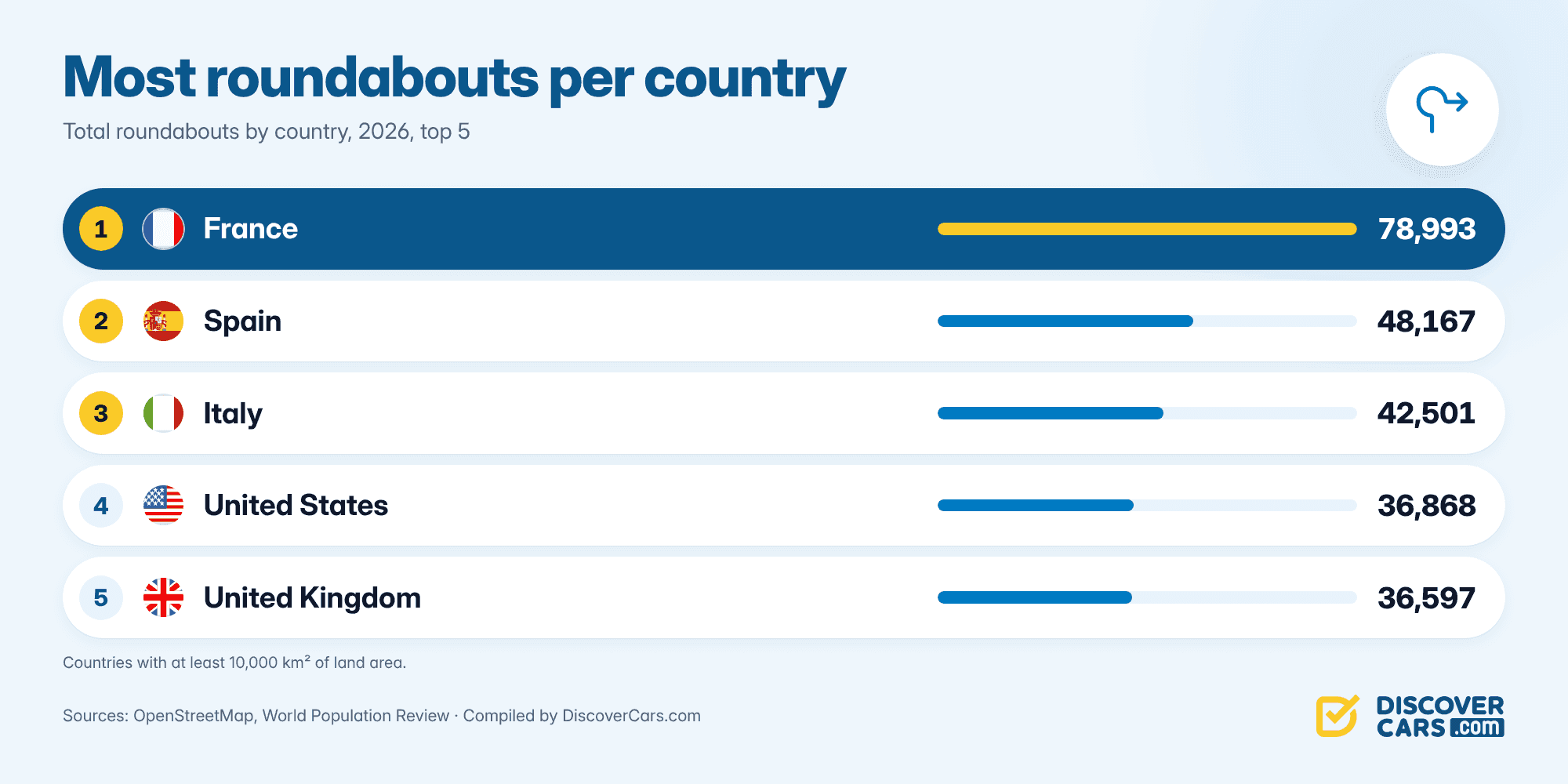
France comes out, as it did in 2023, with the highest number of roundabouts in total, 78,993. This is 64% higher than the country in second place, showing that France is the undisputed leader around the world in terms of the number of these intersections.
France also has the highest number of roundabouts per capita – 1,183.5 per million people. It also has the fifth highest number of roundabouts per square km, at 0.14. This country certainly makes the most of its roundabouts and is well known for adorning them with topiaries, sculptures and sometimes special festive decorations that are just there for the season.
In second place, Spain has 48,167 roundabouts in total. This country also appears in the ranking of places with the most roundabouts per capita, ranking in fourth place with 1,006.6 roundabouts per million people.
Spain landed outside the top 5 countries with the most roundabouts per square km, although it was just within the top 10 in ninth place, with 0.1. This country is actually home to Europe’s largest roundabout, which is 1.3 km long – you can find this feat of engineering in Esparragosa de Lares in Badajoz.
Spain may be roundabout heavy, but in a previous piece of research we ranked it the easiest country to drive in, due to factors like road investment per capita.
Italy landed in third place, with a total of 42,501 roundabouts. This country just missed out on the top 5 for roundabouts per capita, as it has 721.26 of these intersections per million people, putting it in sixth place. Italy also ranked sixth for number of roundabouts per square km, with 0.14.
Piazza Venezia is home to the largest roundabout in Rome. Four major roads meet at this square, making it a very busy spot for drivers trying to make their way through the capital. Overlooked by a number of historic buildings and monuments like the Altare della Patria monument, locals and tourists alike agree that this part of the city is best appreciated on foot rather than by car!
The United States is much less known for its roundabouts than Europe, partly because of differences in road design – American roads are often a great deal wider than those in Europe, especially small country roads or historic cities with Medieval origin. Nonetheless, the US has still made its way into the top 5 countries with the highest number of roundabouts, at 36,868.
However, its entry in the top 5 might be influenced by its sheer size – when you look at the number of roundabouts per capita, it ranks well outside the top 10 with only 105.63 roundabouts per million people. And its number of roundabouts per square kilometer is only 0.0039.
The United Kingdom is famously where what’s known as the modern roundabout was standardized, including the rule that vehicles joining a roundabout must give way to those already on it. Trials in 1963 found that it improved traffic flow by up to 10% – suggesting that even those of us who don’t particularly enjoy navigating these intersections get some benefit from them!
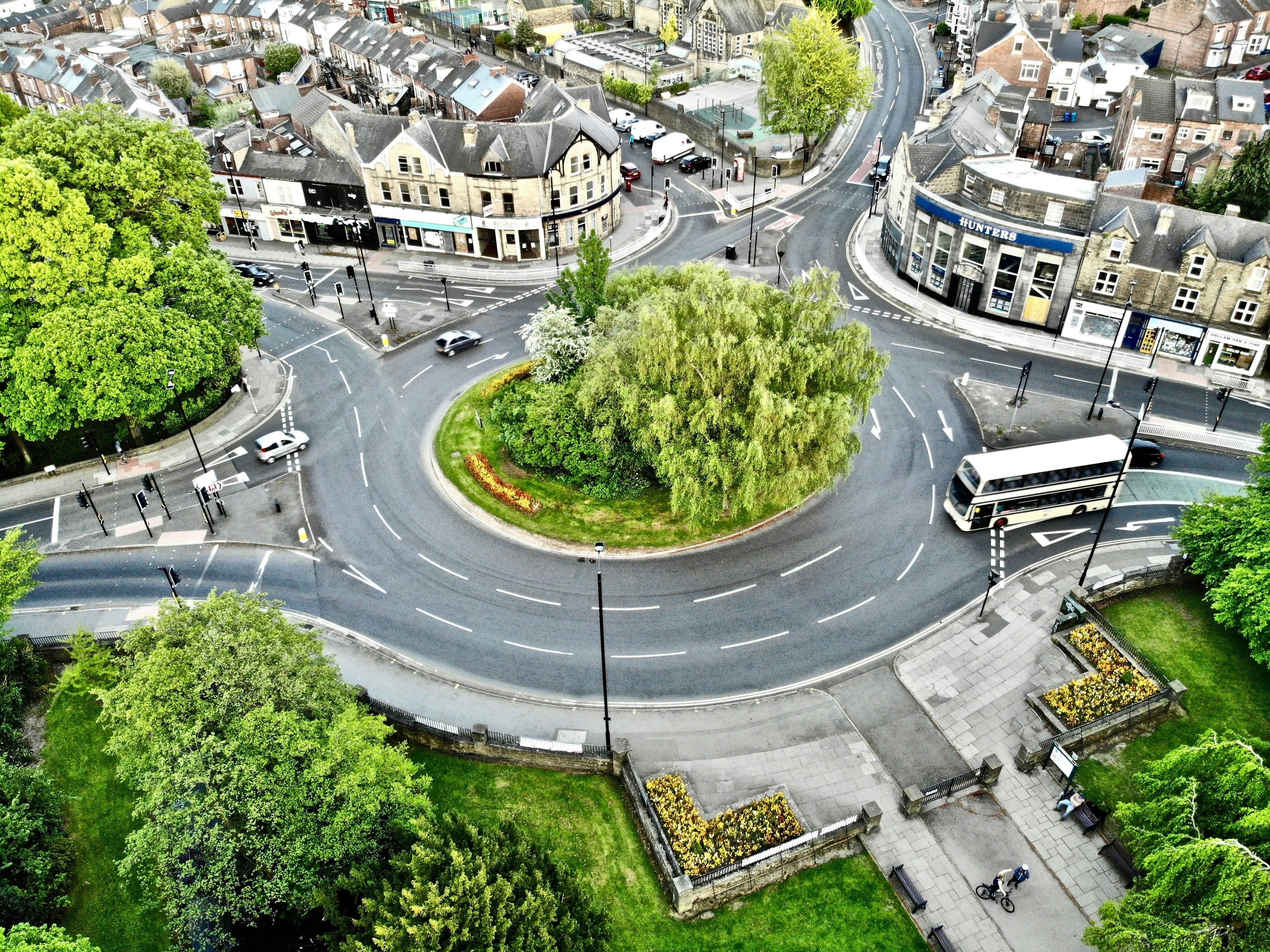
The UK has 36,597 roundabouts in total, nearly as many as the US, despite being 40 times smaller. It has 523.3 roundabouts per million people, placing it outside the top 10. However, the United Kingdom ranks within the top 5 for the highest number of roundabouts per square km, at 0.15.
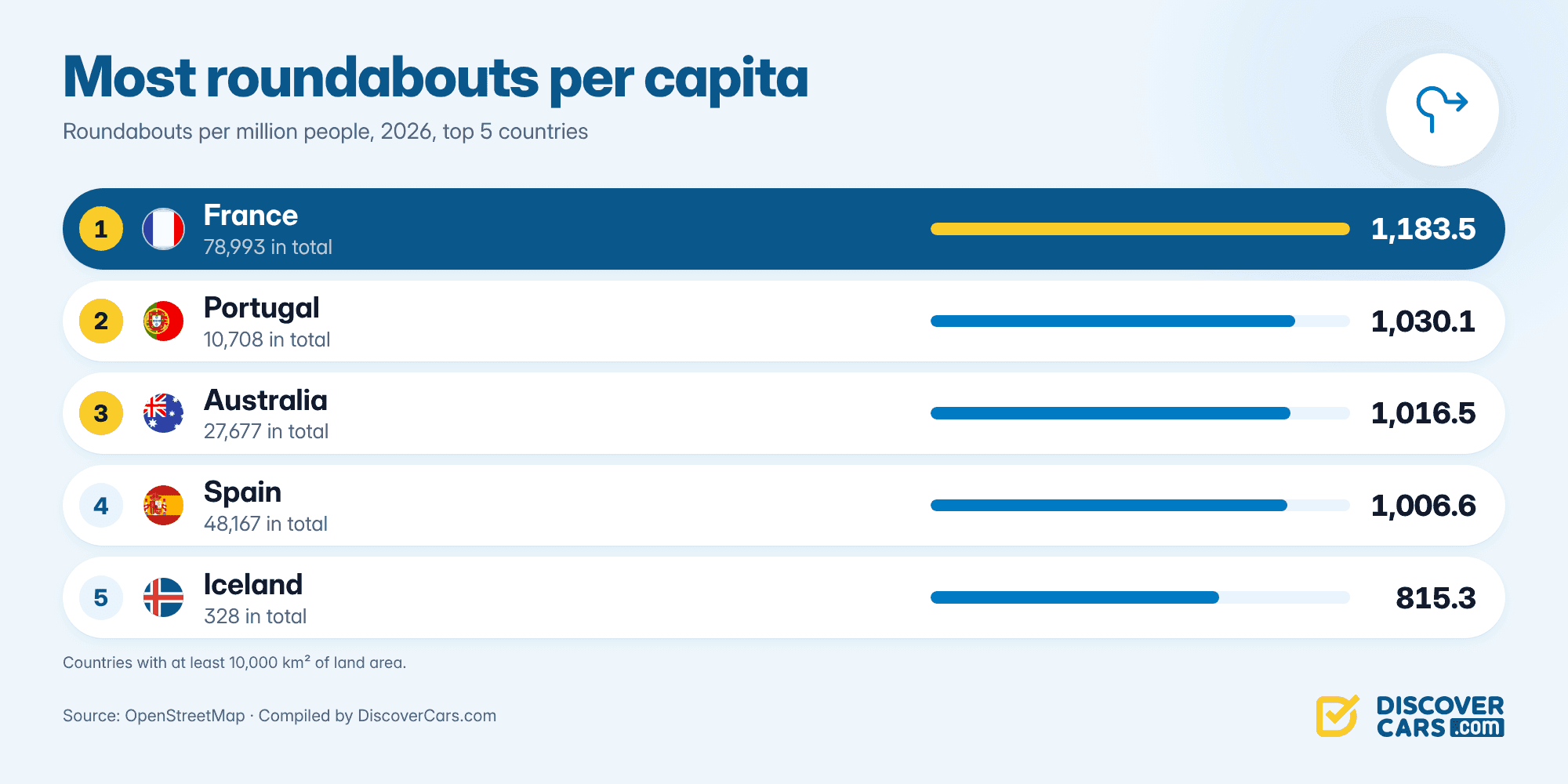
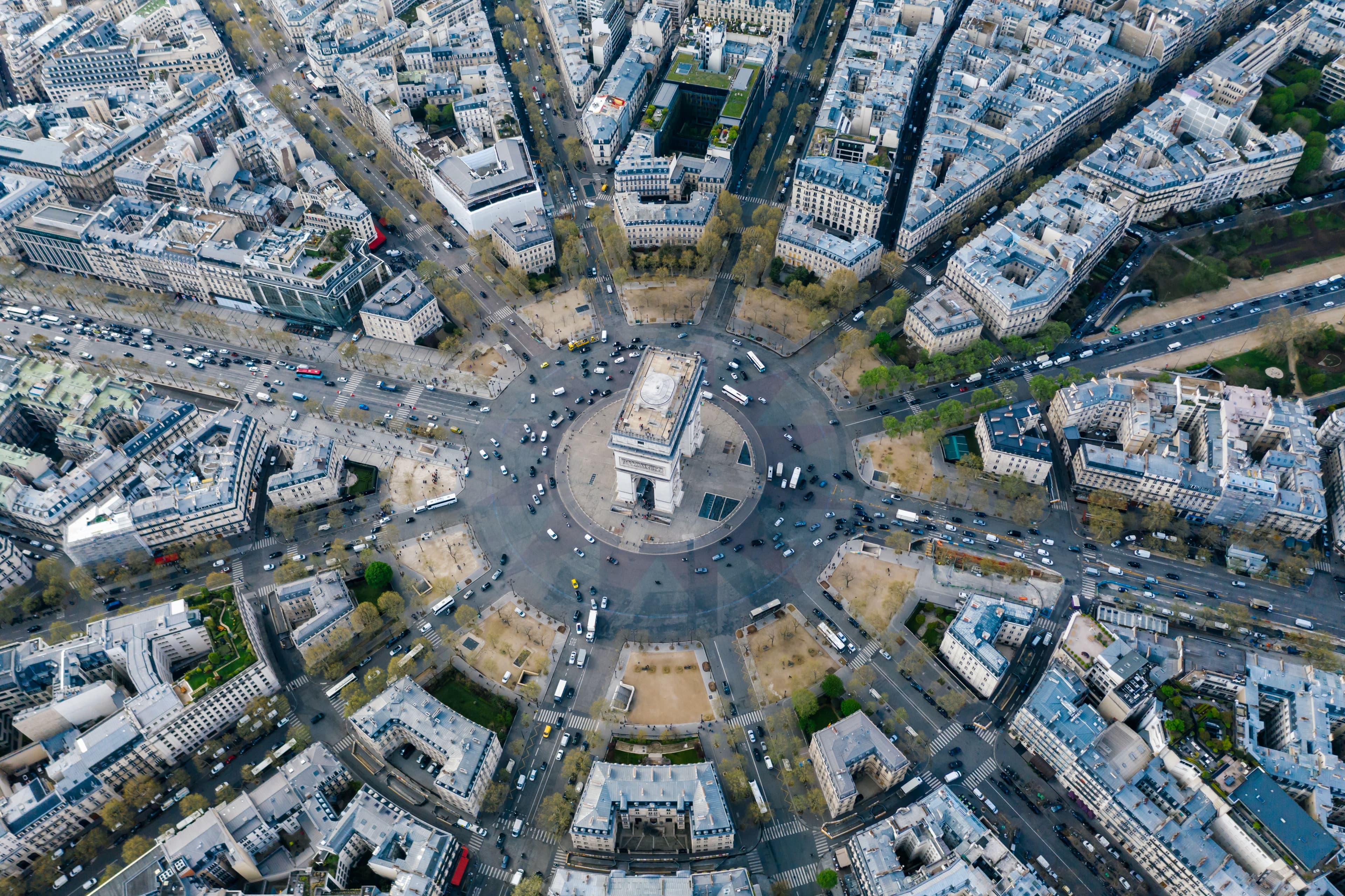
With 1,183.5 roundabouts per million people, France is squarely in the lead on this metric. The Place Charles de Gaulle in Paris is France’s most famous roundabout. This massive star-shaped intersection has 12 lanes, with the magnificent Arc de Triomphe monument at its centre. Pedestrians have to walk underneath the intersection in tunnels to safely reach the monument (and get their vacation photos beneath it)!
France probably needs all these roundabouts, because the roads can get so incredibly busy. In fact, this country ranked ninth in our survey last year in which we asked 12,015 of our customers around the world to rate the roads in different countries in terms of how busy they were. As a global car rental comparison and booking site, we’re able to conduct all kinds of interesting surveys with our database of customers, asking them for their opinions and experiences when it comes to all things driving.
Next up, Portugal has 1,030.1 roundabouts per million people, putting this country in second place. In total, there are 10,708 of the intersections in Portugal, which lands it in tenth place overall. And when we look at how many there are per square km, it’s within the top 10 on this metric too, with 0.12 putting Portugal in seventh place.
In Albufeira, you can find two roundabouts that make great landmarks for tourists traveling around the country by car. The Globe Roundabout features a sculpture of a metal globe with a built-in fountain, while nearby on Avenida dos Descobrimentos, another roundabout features two huge, colorful sculptures of wristwatches.
Australia is next in the ranking, with 1,016.5 roundabouts per million people. However, despite a high number of roundabouts when measured against the population, this country’s ranking on the other metrics looks very different. As a very large country, it has far fewer roundabouts per square kilometer than other places, with only 0.0036 roundabouts per square km. In total, there are 27,677 roundabouts in Australia.
One particularly tricky roundabout in Australia is the Mooroolbark Five Ways intersection in the city of Melbourne. At this junction, drivers need to navigate three roundabouts that are all connected together. While it helps manage traffic flow, it might feel very daunting to newer drivers.
In fourth place, we have Spain with 1,006.6 roundabouts per million people. Here are two examples of unusual intersections in the Madrid region. First, there’s the roundabout with a cemetery at the centre in Villanueva de la Cañada. More whimsically, there’s one with a sculpture of a giant rollercoaster near Avenida de Carabanchel. Look out for these two on a road trip through this region!
Finally, to round off this section, Iceland landed in fifth place – the only country in the top 5 with fewer than 1000 roundabouts per million people. There are 815.3 roundabouts per million people in Iceland. In total, that’s actually only 328 roundabouts – and an even smaller number of the intersections per square km than Australia, coming in at 0.0032.
Tourists taking a road trip through Iceland should bear in mind that traffic rules are a little different here, as on its two-lane roundabouts, the inner lane always has the right of way. It’s always best to get familiar with the traffic laws ahead of time if you’re planning on traveling by car on your vacation, as they won’t always be what you’re used to!
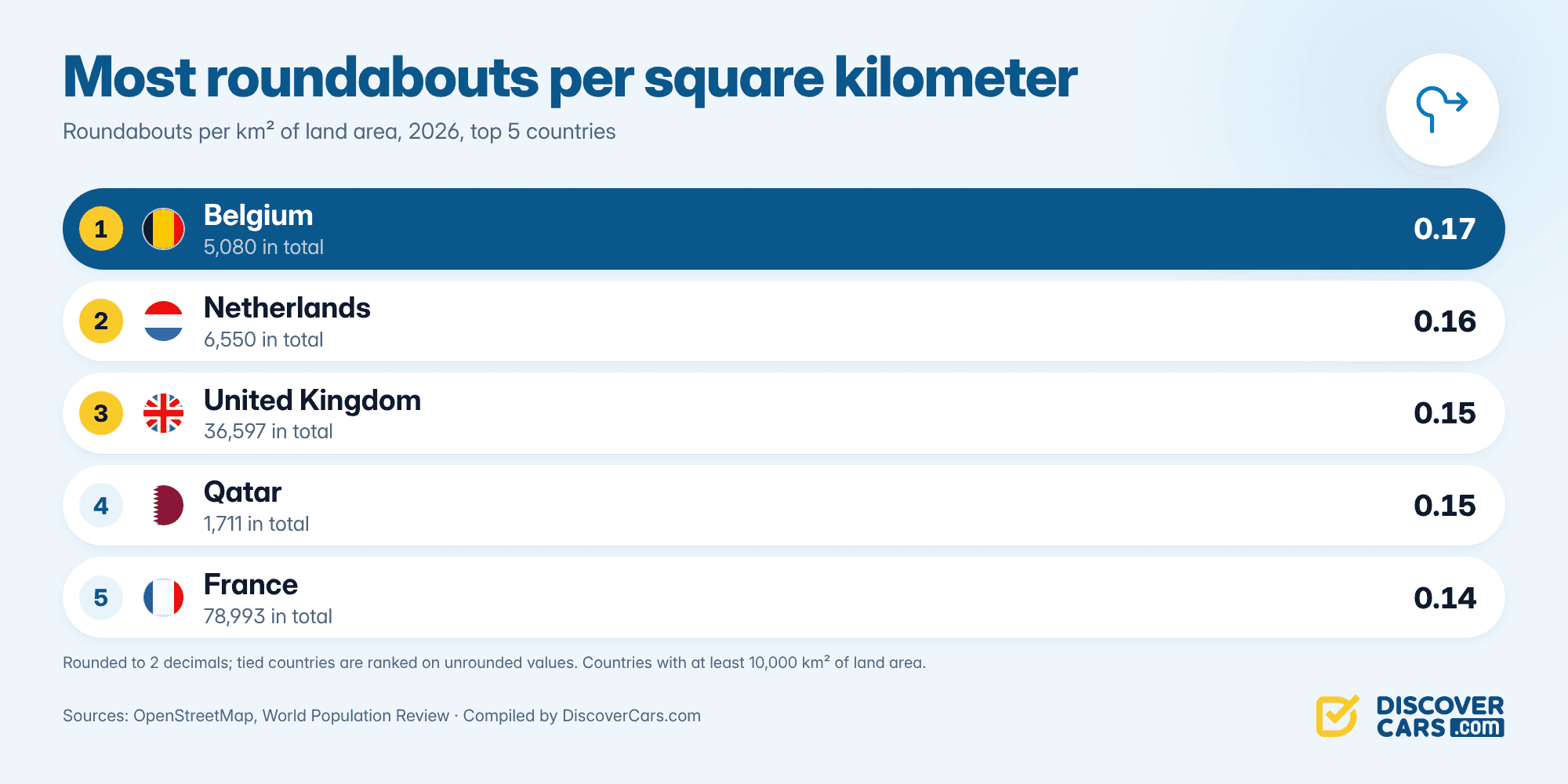
When looking at which countries have the highest density of roundabouts per square kilometer, the countries in the top 5 are all pretty close together, but Belgium comes out on top with 0.17. At 30,689 km, it has 5,080 roundabouts. And when you compare the number of these intersections to the size of the population, there are 431.4 roundabouts per million people.
One of Belgium’s most notable roundabouts is in the town of Ypres. At the roundabout’s centre, a sculpture of a tap appears to float in the air, with a cascade of water pouring from it. Here’s how the optical illusion works: hidden in the stream of water, a pipe supports the sculpture.
Next up, the Netherlands is only just behind with 0.16 roundabouts per square km – that’s 6,550 roundabouts against a total land area of 41,850 square km. The Netherlands has 355 roundabouts per million people.
Urban Dutch roundabouts have an unusual feature that makes them different from their equivalents in many other countries. A separate track allows cyclists to make their way around without having to share a lane with cars. Considering the popularity of cycling in the Netherlands, it makes total sense!
As well as having the fifth highest number of roundabouts in general, the UK has the third highest number of roundabouts compared to land area, rounding out to 0.15 of the intersections per square kilometer. That’s despite the fact that the UK is larger in size than many of the other countries with the most roundabouts compared to land area, with a size of 242,900 square km.
In fourth place, and one of the few countries outside Europe to feature in our ranking, the number of roundabouts per square kilometer in Qatar rounds out to 0.15. We only featured countries with a land area above 10,000 and at 11,586, Qatar only just sneaks in there. There are 1711 roundabouts in total in this country, and 539 roundabouts per million people.
In the coastal city of Al Khor, you can find a roundabout that nods to the area’s fishing heritage – a 9-foot sculpture of a leaping fish sits at the centre.
And finally, the country that appears in all three rankings in our piece – France. Its number of roundabouts compared to land area works out at 0.14 per square kilometer.
The Parisian photographer Romain Ruiz has a 2026 project collecting images of ornately decorated roundabouts across France – check out the Rond-Point section on his website to find examples. Decorated with sculptures of plants, animals and people to all kinds of objects and miniature buildings, there are plenty of unusual and colorful roundabouts across the country.
So there we have it – these are the roundabout capitals of the world. Even if you’d rather avoid routes with too many roundabouts, we hope that our round-up of the countries that have the most has been interesting and entertaining. Even if you don’t enjoy navigating them, we think some of the roundabouts might be worth driving past at least, to see the sculptures or decorations on them!
Our advice when planning an international road trip is to always familiarize yourself with the local rules of the road. Otherwise, the design of road elements like roundabouts might take you by surprise – especially if you’ve never seen ones as they have in the Netherlands, with a separate lane just for bicycles!
If you’re planning a driving vacation, we hope you consider booking with us. We were the most visited global car rental comparison site in February 2026 and can help you find the perfect rental car in 164 countries around the world.
From underground roundabouts to enormous traffic circles surrounding historic monuments, there are plenty of unusual roundabouts to discover across Europe. Here are 20 more destinations with interesting roundabouts, along with the nearest airports where you can rent a car to explore them.